Pjila'si
Ep-ja-la-see — "Welcome" in Mi'kmaw
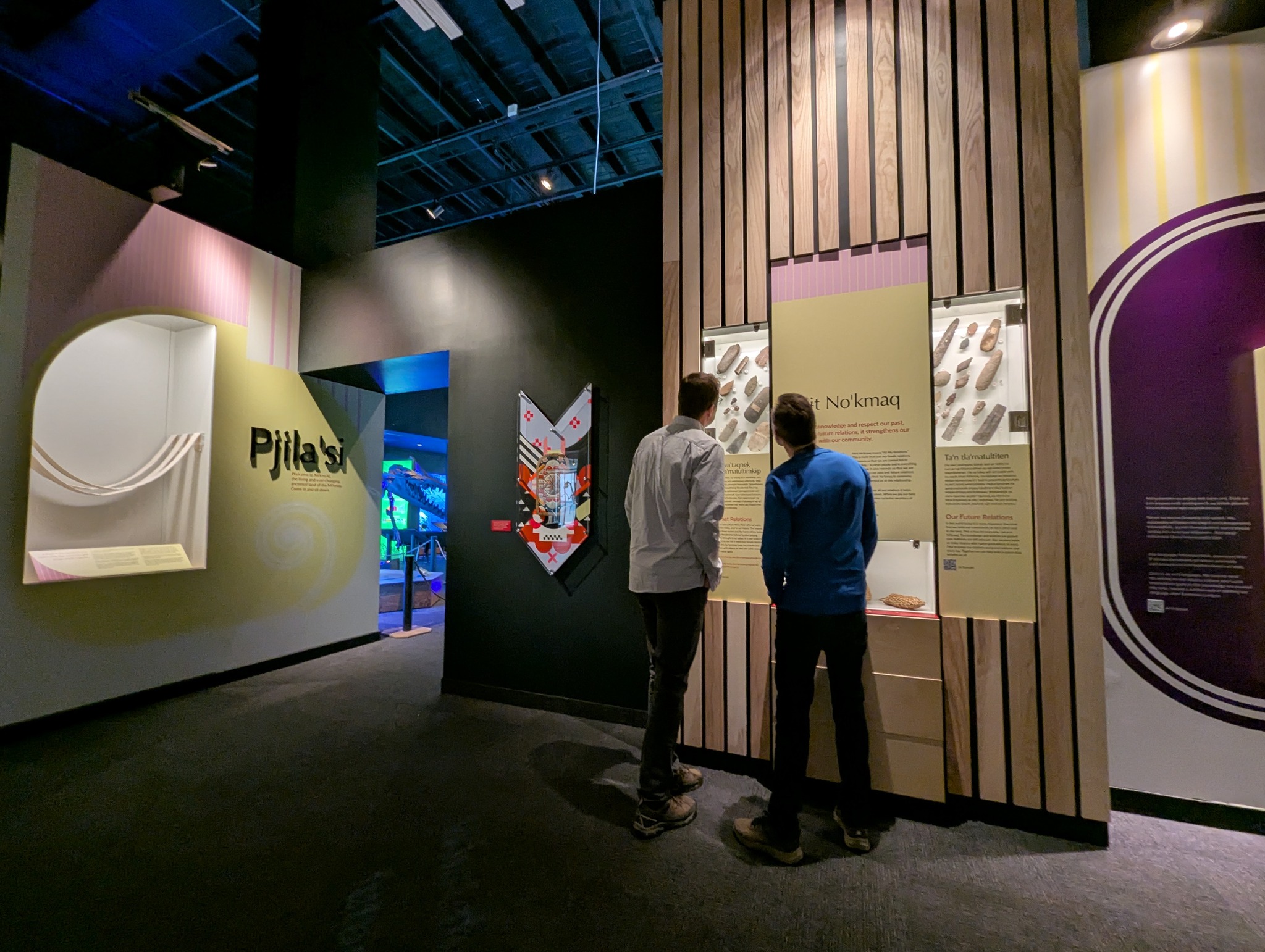
An 11-exhibit permanent installation at the Museum of Natural History in Halifax — replacing a 50-year-old showcase with a community-led experience that lets Mi'kmaw culture speak for itself.
Role
UX / UI Designer
Client
Museum of Natural History
Agencies
IX Labs
Panther Creative
Opened
March 7, 2025
01 — Overview
Static exhibits preserve. Interactive ones invite.
The distinction sounds simple — but replacing a 50-year-old institutional showcase with an experience built by the community it was meant to represent is anything but. The Museum of Natural History in Halifax had a Mi'kmaw exhibit dating back to the 1960s. The community's own assessment: it was cold, object-focused, and failed to represent a living people. Pjila'si was the chance to start over — a new permanent exhibit developed with the Mi'kmaw community from the ground up.
The Mi'kmaw Advisory Group guided every step: selecting cultural belongings, shaping the stories, deciding what gets said and how. IX Labs' role was to bring that content to life through technology — not to interpret it. That meant working in close relationship with Mi'kmaw artists, storytellers, and cultural advisors throughout — extracting and curating content collaboratively, then returning every design decision for approval to ensure the message was accurate, consistent, and theirs.
"The original showcase did not represent the Mi'kmaw people well. We need to add humanity back into the culture and their belongings."
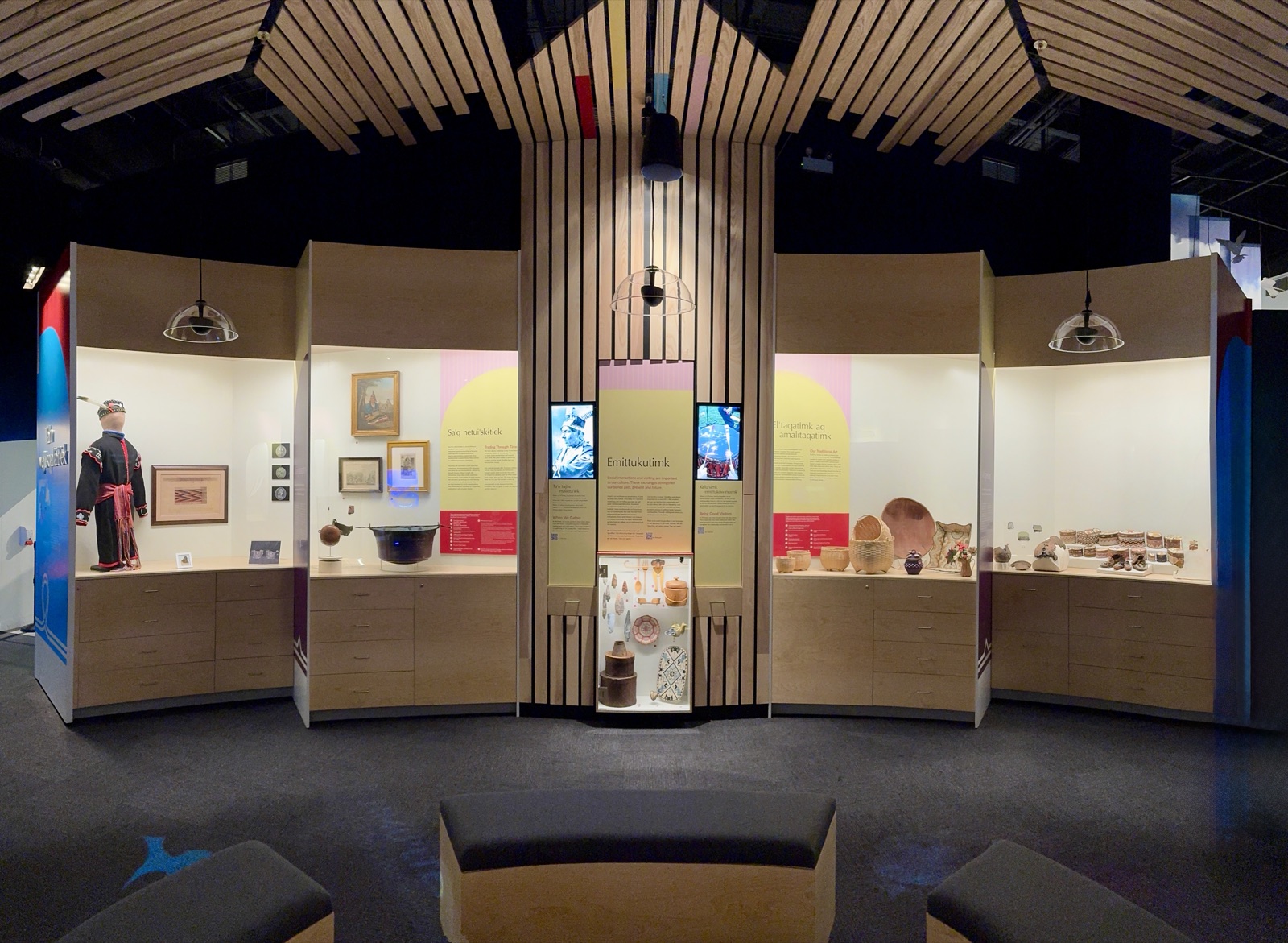
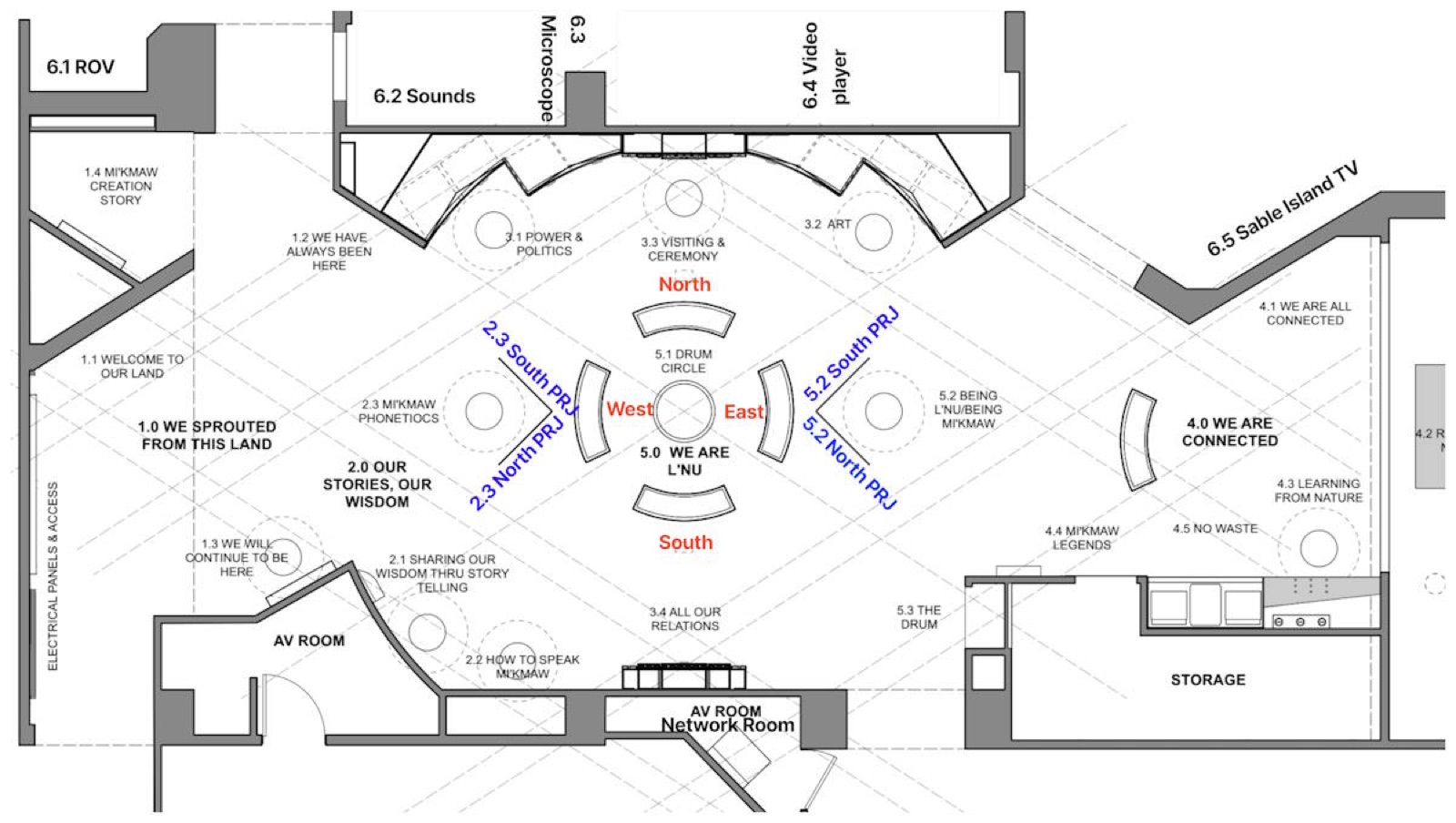
The result is an 11-exhibit system spanning language, storytelling, geography, history, traditional knowledge, and contemporary Mi'kmaw life — designed not just for a single visit, but for repeat encounters. Different layers reveal themselves over time.
02 — My Role
Core designer on the digital side.
I was the lead UX/UI Designer at IX Labs, responsible for the digital experience across all eleven exhibits. IX Labs handled the interactive and digital layer; Panther Creative built the physical structures. My work sat at the intersection — designing experiences that depended on both, and adapting when the two sides didn't align.
The core challenge of the role wasn't the design itself — it was that creative control was distributed. Cultural content was being produced by Mi'kmaw artists, animators, storytellers, and community advisors on their own timelines. As an outsider to the culture, I couldn't make calls on that content — every ambiguous decision had to go back to the community for context. That meant building interaction frameworks first, then adapting when content arrived — sometimes in a different format, at a different quality, or later than expected.
When a video came back with a subject wearing green against a green-screen background, I flagged it for a reshoot. When audio didn't meet standard, I escalated to the audio engineer. When Exhibit 3.3's content came back in landscape when the physical installation needed portrait, I designed a Ken Burns approach to make the format work — and got it approved. That kind of reactive problem-solving was as much a part of the role as the original design work.
The cross-team structure also required active management. Bi-weekly PM calls between IX Labs and Panther weren't enough — by the time issues surfaced, both teams had already moved on. I set up a shared folder for live design and layout updates, and started inviting Panther's PM into my design meetings directly, so the fabrication team knew what was coming before it became a conflict.
UX & Interaction Design
Designing the full interaction logic for each exhibit: decision trees, sensor states, loop behaviour, attractor screens, and content transitions. Built as frameworks first — flexible enough to receive content that hadn't arrived yet.
UI Design
On-screen interfaces for the interactive exhibits: the Mi'kmaw place names map, the language station, phonetics screens, and video experiences.
Content QA & Direction
Reviewing incoming content from the Mi'kmaw community against design requirements. Flagging production issues — green screen errors, audio quality, format mismatches — and resolving them without overstepping cultural authorship.
Cross-team Coordination
Managing the dependency between digital and fabrication. Created a shared asset folder and integrated Panther's PM into design reviews to surface conflicts before they became blockers.
03 — The Experience
Eleven exhibits. One experience system.
Mi'kmaw culture is primarily oral. Knowledge passes through storytelling, not writing — and most of what exists in the written or visual record is incomplete, filtered through a colonial lens. That reality shaped every design decision in Pjila'si: audio over text, human voice over institutional copy, interaction over passive reading. Technology wasn't the point. It was the means of making a living culture feel alive.
Each exhibit uses a different interaction model by design — touch, presence, physical buttons, audio narrative, projection. No two are the same. The variety keeps the space surprising across a full visit and ensures visitors who engage differently always find a way in.
Design spotlight — Exhibit 1.3: Mi'kmaw Cultural Landscape · 65" 4K Touch Screen · Interactive Map
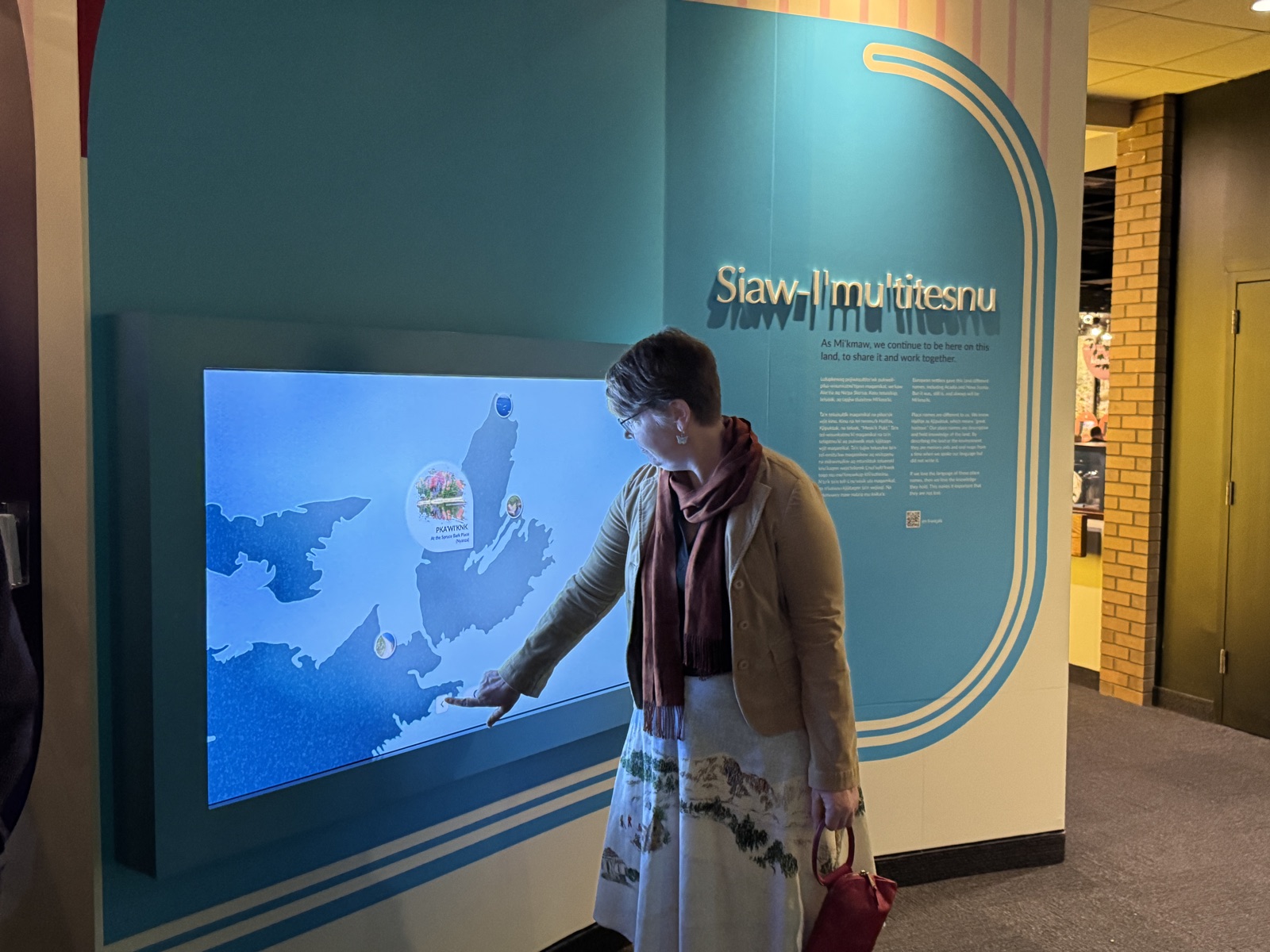
The brief was to design an interactive map of Mi'kma'ki — the traditional Mi'kmaw territory — where visitors could explore place names in Mi'kmaw. Mi'kmaw place names are verb-based and descriptive. They paint a picture of the land through language, change by season, and are almost never named after a person. The challenge was making that logic legible to a general audience on a 65" screen, without flattening it.
Accessibility shaped the layout from the start. Museum exhibits must accommodate visitors of all abilities — which meant all touch interactions and on-screen buttons had to be positioned low enough for wheelchair users, children, and visitors who couldn't reach the top of a large display. That constraint influenced the entire layout hierarchy.
The harder problem was colour. My initial instinct was to use colour to differentiate regions on the map — standard cartographic thinking. The Mi'kmaw Advisory Group flagged it immediately: colouring regions differently would imply distinct tribal territories, which carried political meaning the community had not agreed to. The solution was to strip the map back to a monochromatic palette, removing any implied division, and let the images carry the saturation instead. The photographs became the focal points — their colour naturally drawing the eye against the neutral map background, while the map itself remained culturally neutral.
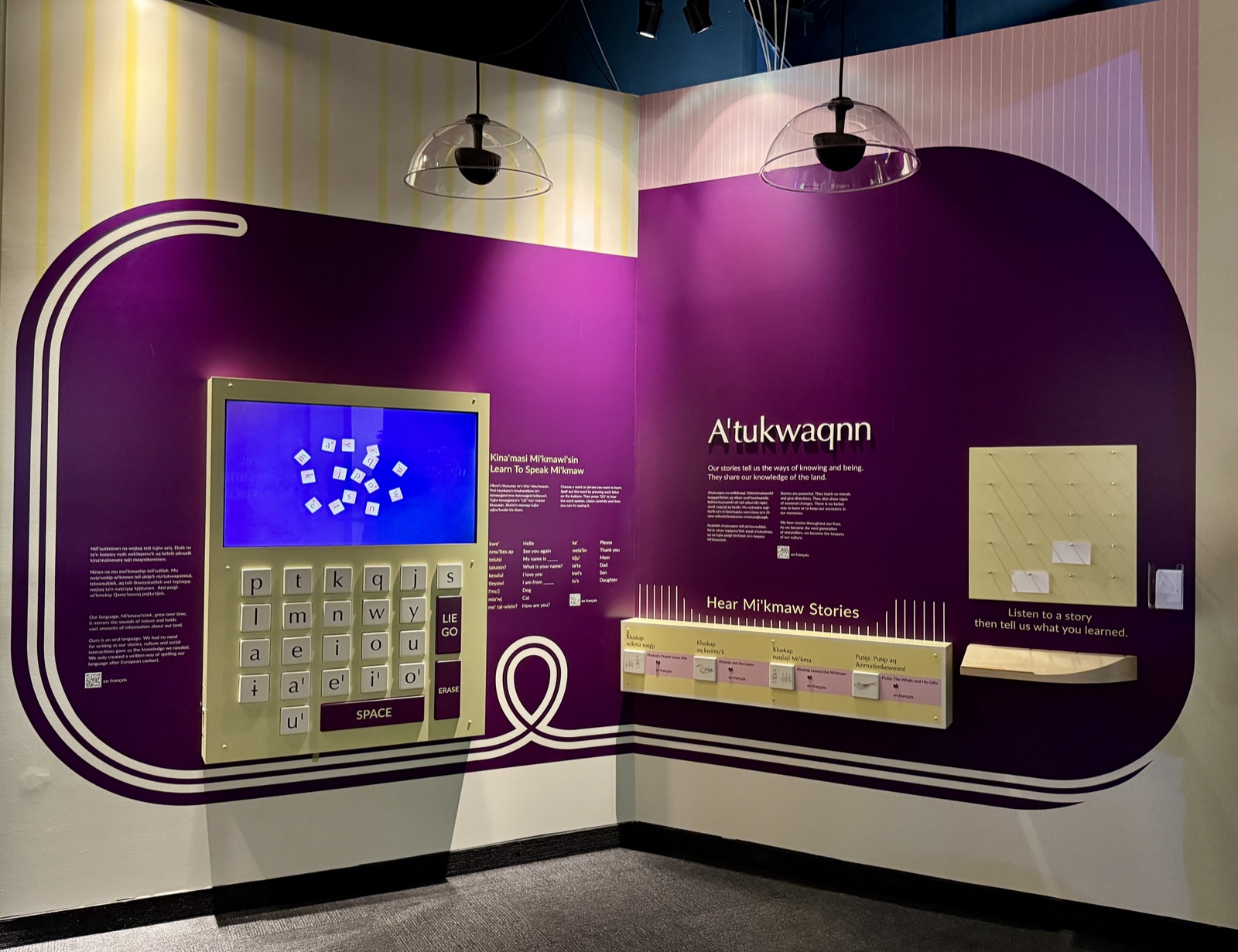
Design spotlight — Exhibit 2.2: How to Speak Mi'kmaw · 43" Touch Screen · 20-Button Nexmosphere Module · Language Station
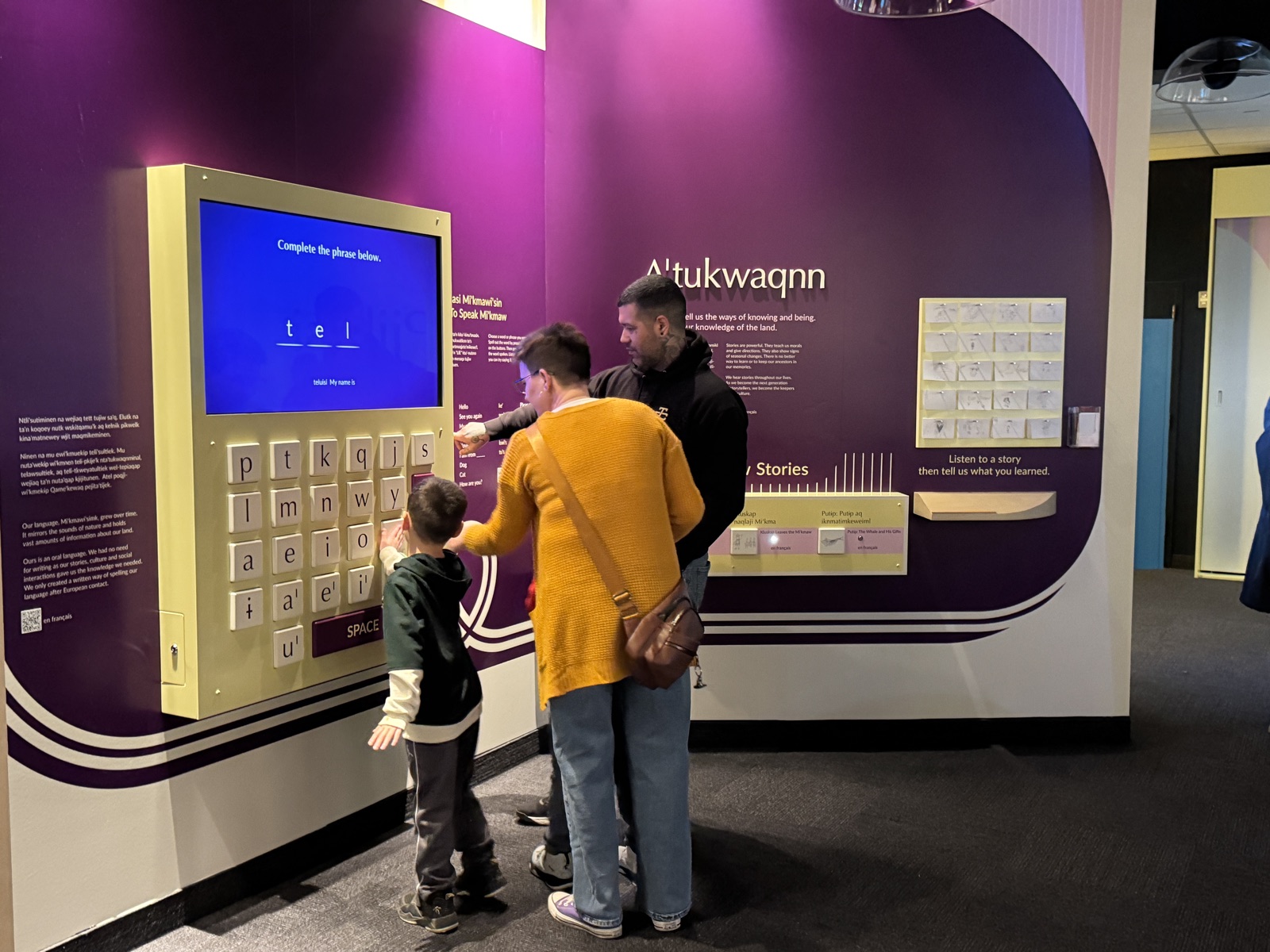
Inspired by the Speak & Spell toy from the 1980s — visitors press physical buttons to hear individual Mi'kmaw sounds, then hear how they combine into words and phrases. The content was developed with a Mi'kmaw language specialist, covering phonetic structures that make Mi'kmaw distinct: the shwa vowel, the absence of a hard "r" sound, sounds with no English equivalent.
The UX challenge was attention management at scale. The station is large — and when a visitor is standing close to a 43" screen, looking left and right to cross-reference the word list with the buttons below is genuinely tiring. The initial layout put the word list on the right side of the screen, which meant constant head movement during the interaction.
The solution was progressive disclosure: the word list stays on the right at the start, giving visitors time to read and choose. Once they press their first button, the possible words shift to the bottom of the screen — within sightline of the buttons, keeping focus contained to a single area. The interaction becomes more natural, more like typing than reading. Visitors could explore spelling Mi'kmaw words without constantly breaking their attention.
Designing for large-format screens presents a constraint most digital designers don't encounter: the hardware often isn't available until close to installation. My workaround was using a projector to test interactions and scale at the correct size before the physical unit arrived — catching layout and legibility issues that would never surface on a laptop screen.
Design spotlight — Exhibit 2.3: Mi'kmaw Phonetics · Dual Projection · Proximity Sensor · Directional Speakers
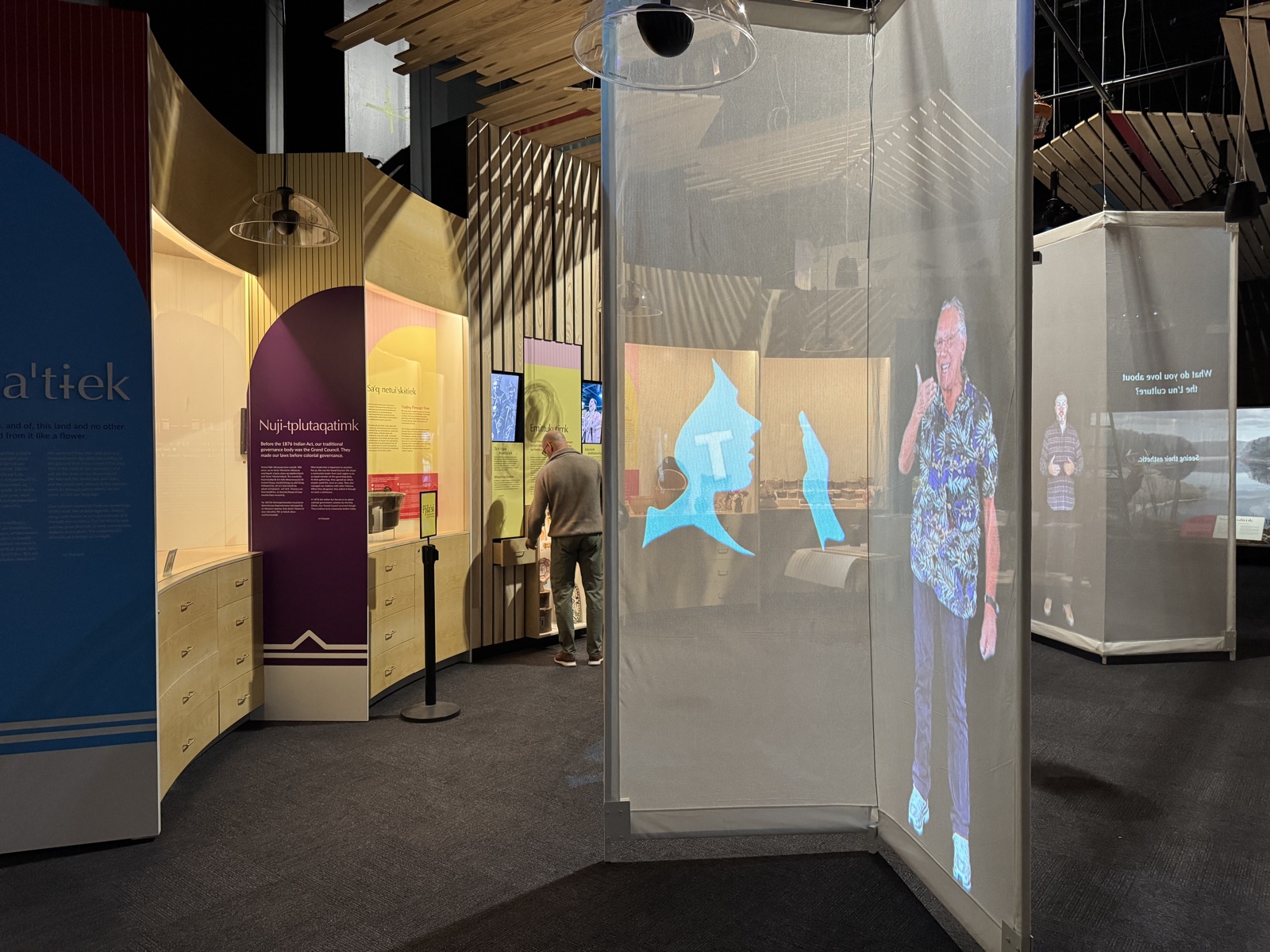
The concept was a two-screen projection experience arranged in a V-shape: the right screen showing a Mi'kmaw language specialist speaking directly to the visitor, the left screen showing animated graphics that illustrated the concepts being taught — like a lecture paired with a visual explainer. I designed the concept and structure, sketched the initial layouts with input from the community and a team member, then handed off to the animator to produce.
The physical execution required material testing. Short-throw projectors would be used — but scrim material and projection angle both affect visibility in ways that can't be confirmed on screen. We tested different scrim materials to validate visibility and found that tension mattered: a poorly tensioned scrim would distort the video. The testing also determined the exact video ratio needed for the angled surface, which fed directly back into the production specs for the animator.
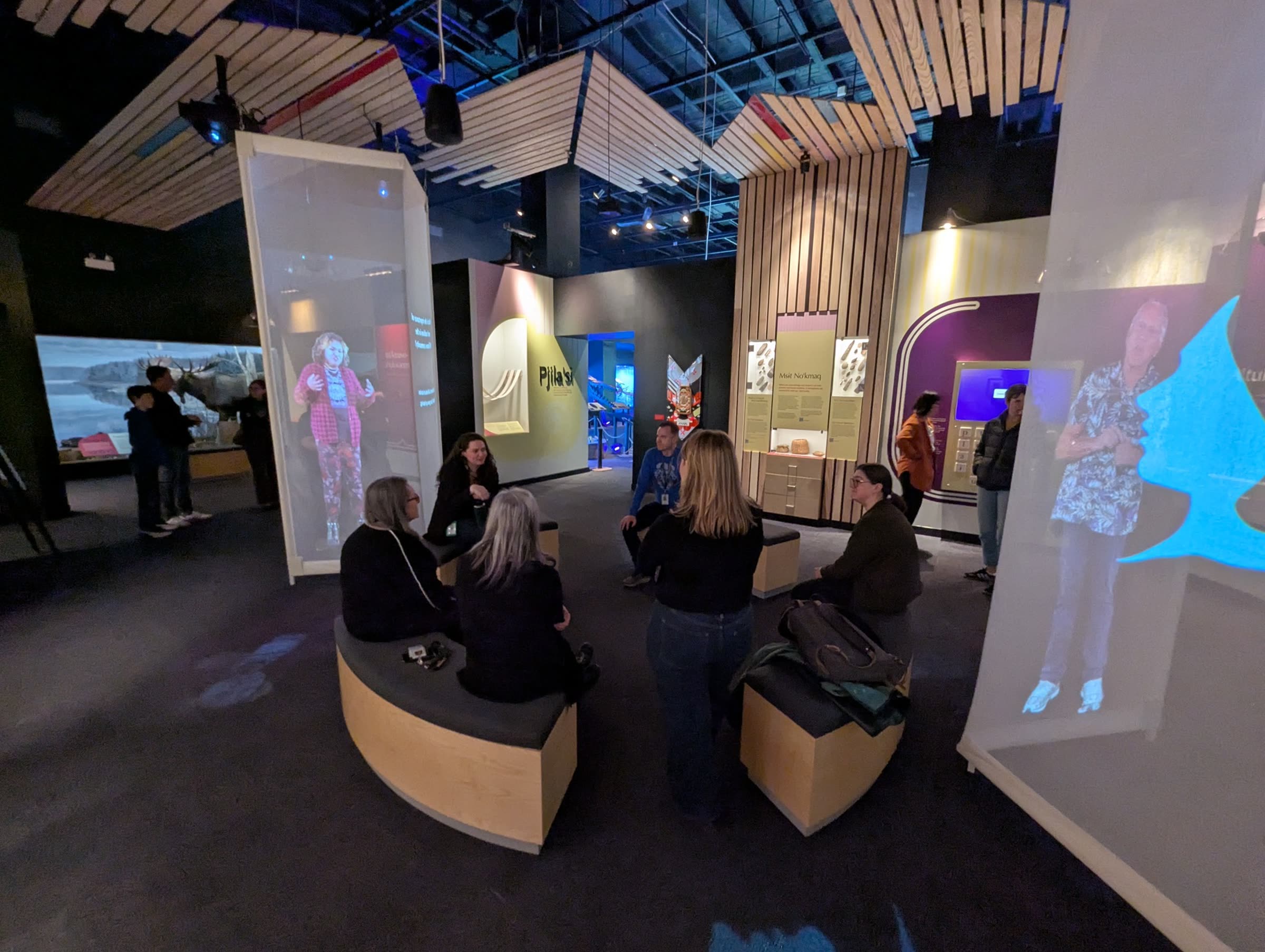
Directional speakers were used instead of open audio — sound that only reaches a visitor standing in the correct position, rather than bleeding into the rest of the exhibit. Combined with the proximity sensor, the experience only activates when someone is actually there. Visitors become active participants rather than spectators walking past a looping screen.
The remaining eight exhibits
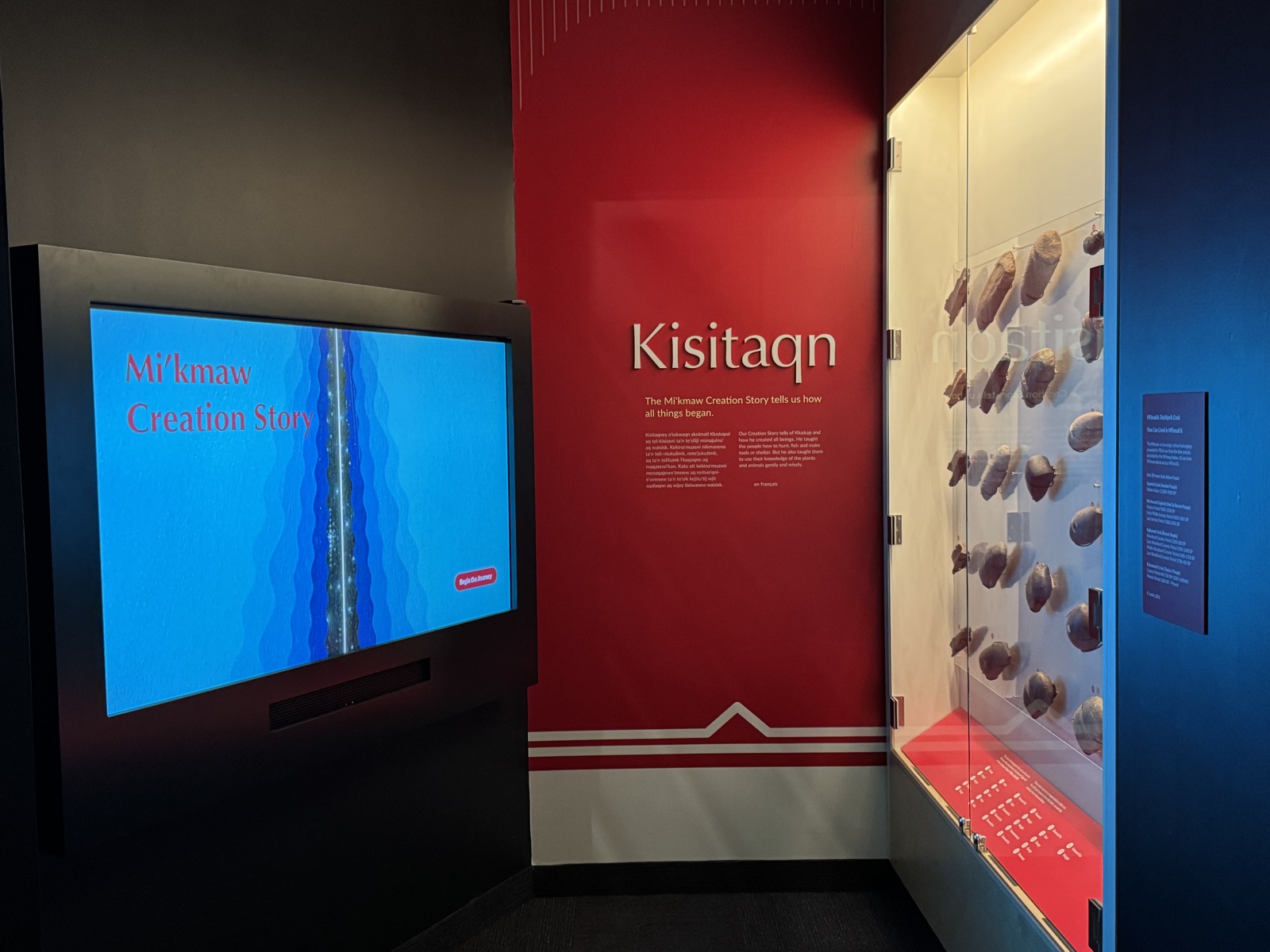
1.4
Mi'kmaw Creation Story
65" Display · Animated Film · Mi'kmaw Artist
An animated film of the Mi'kmaw creation story, painted by a Mi'kmaw artist then animated by a partner studio. One decision held firm throughout: the story would not be sanitised. Mi'kmaw creation stories contain violence — and the community considers it important that children encounter the real narrative.
2.1
Sharing Our Wisdom Through Storytelling
4-Button Audio Station · Physical Paper Reflection
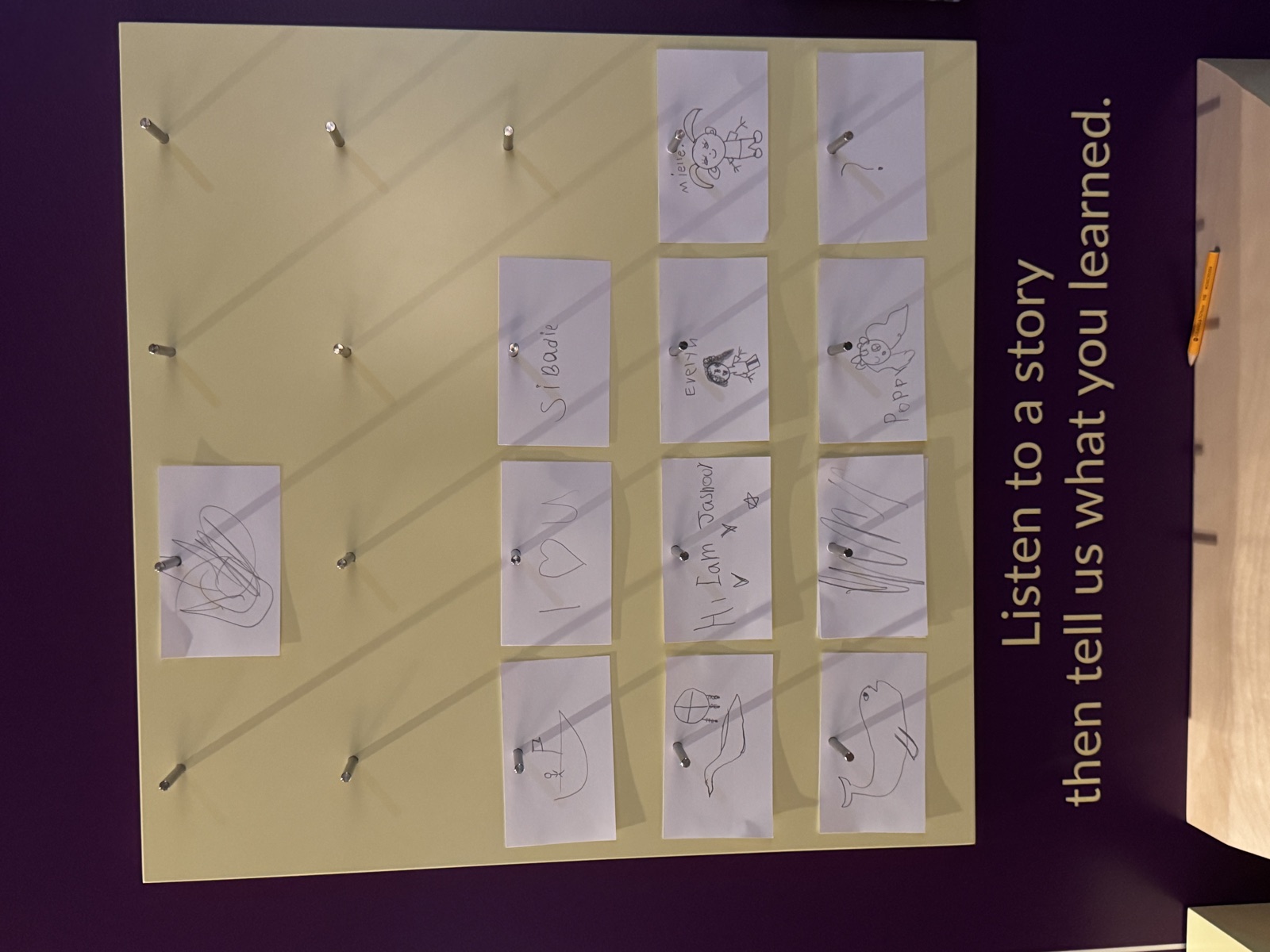
Visitors choose from four one-minute audio stories, then write their thoughts on paper and place it in a box that stays in the exhibit. The goal: shift from passive consumption to active connection — not "what did you learn?" but "how does this connect to your own life?" The box fills over time, becoming part of the exhibit itself.
3.1
Power & Politics
Motion Sensor · Audio Narrative
Audio triggered as visitors approach the artifact case, narrating the evolution of Mi'kmaw governance — traditional political structure, the significance of Treaties, trade during pre- and post-contact periods. Delivered conversationally, not scripted — members of the Advisory Group spoke freely to strong leading questions.
3.2
Art Showcase
Motion Sensor · Audio Narrative
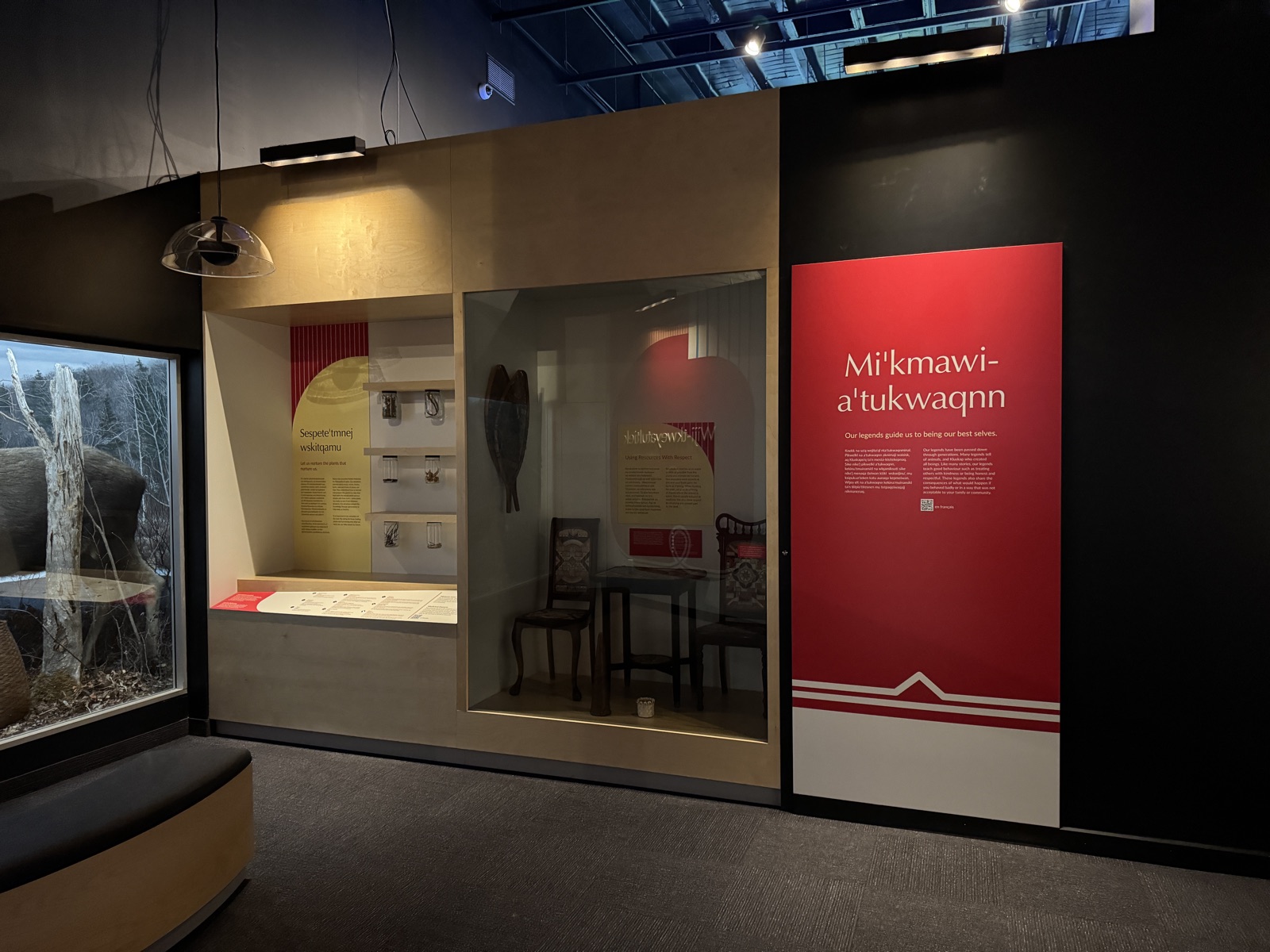
Audio plays as visitors approach displayed artworks. The framing: Mi'kmaw artisans adapted their craft to sell to colonists — these objects are evidence of a living culture that evolved under pressure, not a frozen tradition.
3.3
Mauomi Gatherings
Motion Sensor · Synced Video + Audio
A portrait-format screen showing Mi'kmaw cultural gatherings — historically on the left, contemporary on the right. The community's visual archive was entirely landscape; portrait is a digital-age format. I proposed a Ken Burns approach — slow pans and zooms across landscape photographs — to bring movement to the content and make the format work without cropping out what mattered.
4.3
Traditional Plants & Medicine
10-Button Nexmosphere Module · Optic Fibre · Physical Jars
Mason jars of traditional Mi'kmaw plants on shelves, connected via optic fibre to physical buttons. Press a button: hear the Mi'kmaw name and its traditional use. The mason jar references a real tradition — Mi'kmaw women historically used them to collect plants from nature. The physical object carries meaning before a visitor touches anything.
5.1
Central Soundscape
Presence Sensor · Ambient Audio
A low ambient soundscape of Mi'kmaw drumming and singing throughout the entire space, becoming more focused as visitors enter. A cooldown period prevents overload. The drum grounds the whole experience before visitors engage with a single exhibit.
5.2
What It Means to Be L'nu
Dual Projection · Proximity Sensor · Screensaver to Immersive
Two ultra-short-throw projectors onto transparent screens — visible from both sides, giving the visuals an almost ethereal quality. In idle mode, an ambient attractor draws visitors in from across the room. As they approach, contemporary Mi'kmaw life unfolds: children in Mi'kmaw school, women doing quill work and basket weaving, artists and musicians. A narrated soundscape asks: what does it mean to be L'nu — a person — in Mi'kma'ki today?
04 — Design Decisions
Principles that held across every exhibit.
Audio over text — because the culture is oral
Mi'kmaw knowledge passes through storytelling, not writing. Most of what exists in the written record is incomplete or filtered through a colonial lens. That's not a gap to work around — it's a design constraint to design from. Nearly every exhibit in Pjila'si leads with audio, human voice, and spoken narrative rather than text panels. The medium matches the culture.
Human voice over institutional voice
Nothing in the experience should sound like a museum. Every piece of content was shaped by the Mi'kmaw Advisory Group — the audio, the narrative framing, the stories chosen. The design's job was to hold the space for that voice, not to mediate it. When the community spoke, the design stepped back.
Designed for return visits
One-time exhibitions lose their reason to exist after a school trip. Pjila'si was designed to reward return visitors — content across several exhibits built to be seasonally updated with different recordings and stories. Visitors who come back will find something new.
A system of different interactions
Each exhibit uses a different interaction model by design. Touch, presence, buttons, audio, projection — no two are the same. The variety keeps the space surprising across a full visit, and ensures visitors who engage differently — children, adults, hesitant visitors — always find a way in.
Physical reflection that stays
The paper takeaway in the Storytelling exhibit was the most unusual decision. Visitors write something and leave it behind. The goal: shift from passive consumption to active connection — not "what did you learn?" but "how does this connect to your own life?" The box fills over time, becoming part of the exhibit itself.
05 — Challenges
Red tape, content dependencies, and cultural trust.
Working with a living Indigenous community on a cultural exhibit is not the same as designing for a brief. The Mi'kmaw community had every reason to be protective — and that protection came in the form of processes: approvals, reviews, and filming restrictions that were non-negotiable. Sourcing the right person from the community, working around availability, navigating who had the authority to approve specific content — these weren't bureaucratic inconveniences. They were the work.
As an outsider to the culture, I couldn't make judgment calls on cultural content when the context wasn't clear. Every ambiguous decision had to go back to the community. That meant timelines slipped, content arrived late, and the design had to be built to accommodate that uncertainty — frameworks that could receive content when it was ready, rather than structures that broke without it.
The red tape wasn't a problem to solve — it was a signal of how much was at stake. Earning trust took longer than any timeline predicted.
The cross-team structure added a second layer of complexity. IX Labs handled digital; Panther handled fabrication. When content format or layout decisions were made by one team without the other's input — as happened with Exhibit 3.3 — it created conflicts that required creative problem-solving under pressure. The shared folder and integrated design reviews I set up weren't process improvements for their own sake. They were a direct response to what broke.
06 — Outcomes
Opened March 7, 2025. Covered nationally.
11
Interactive exhibits designed and delivered
3
National news outlets covering the opening
2025
Opened on schedule, March 7
Pjila'si opened on March 7, 2025 at the Museum of Natural History in Halifax, Nova Scotia. The opening was covered by CBC, CTV, and Global News — and drew responses from the Mi'kmaw Advisory Group, the Nova Scotia Museum, and the federal Minister of Canadian Heritage.
"The Nova Scotia Museum recognized that this exhibit is what reconciliation should be. Museums have shifted away from being only about objects and are more about cultural presentation. This exhibit is unique because it is community led, and the museum gave that responsibility back to community."
— Roger Lewis, Mi'kmaw Advisory Group
"Pjila'si is a welcoming space for connection, learning and reflection. It's been an honour to work with the Mi'kmaw advisory group on this exhibit, which invites visitors to experience the language, stories, and traditions of the Mi'kmaw people in a meaningful way."
— Laura Bennett, Director, Nova Scotia Museum
CBC
Museum of Natural History debuts Pjila'si ↗
CTV News
New exhibit Pjila'si opens in Halifax ↗
Global News
Museum of Natural History debuts new permanent exhibit ↗
07 — Reflection
Retrospective
Pjila'si was unlike any project I'd worked on before — not because of the scale or the technology, but because of what design meant in that context. The work was never just about interaction models or screen layouts. It was about who gets to tell a story, and how design either serves or interferes with that.
The most important skill on this project wasn't design skill. It was knowing when to push and when to step back. The map's colour palette changed because I listened. The creation story kept its violence because the community held firm and I understood why. The best moments in Pjila'si came from the space between what I designed and what the community brought — neither one alone would have been enough.
I also came away with a much clearer understanding of what cross-discipline coordination actually requires. Two teams with different languages, different rhythms, and different definitions of "done" will find the gap between them — the only question is whether you've made that gap visible before or after something breaks. On this project, I learned to make it visible first.